Friday, 20 April 2012

The Hippy Kazoo

I have little time for the hippy aesthetic, so when we pitched up with the kids in a woodland skills workshop in the shadow of Screel Hill in Dumfrieshire, I was a bit put off by the tie-died baggy trousers and unlaced combat boots. Worse was to come: we'd arrived just in time for the group exercises. Kids being invited to hide under a tarp in the middle of a circle of people, then grow into a beautiful flower when we chanted their name. B, perfectly sensibly, declared himself out. As did a growing number of other kids. In fact, as ... was it Phoebe? later admitted, the more group bonding games she tried, the faster people fled.

Fortunately at this point, Phoebe dispensed with the cheesy games and introduced us all to the thing that this lot did best: making good things from wood. Their camp testified to this ability: one extremely handsome cabin made from naturally-shaped logs, joined with pegs and walled with wattle and daub. Exactly the same construction methods as used in the Globe theatre.

They gave B a project: make a kazoo out of a hazel branch and two rubber bands. Here's how it's done:

1) Take one seven year old boy, hand him a (troublingly large and sharp) saw. Bid him saw about three inches off the branch.

2) Hand boy a (troublingly large and sharp) knife. Bid him split the wood lengthwise.

3) He then scrapes the blade down the middle bit of each interior face of the wood, to create a shallow depression.


4) Then he wraps a rubber band lengthwise round one bit of wood, sandwiches both bits together and fastens with another rubber band, and also some little ones round the ends just to be sure.


5) He places his mouth over the hole, blows, creates amusing honking noise, laughs head off.

There you are. Thank you clever hippies.

Monday, 26 March 2012

Guest Post: Geoffrey Thomas of The Unsamaritans Book Club

The Blue Flower by Penelope Fitzgerald

Introduction

Following our book group discussion of ‘The Blue Flower’,James asked me to put together a review. I do so with a certain apprehension because nothing I write will do justice to the subtleties, flavours and textures of this remarkable novel which opens up the smallest window on a period of European cultural history and of lives truly led.

I have little doubt that some readers will be left feeling dissatisfied or short-changed by ‘The Blue Flower’. Penelope Fitzgerald does not do exposition and her sparing style means she frequently asks the reader to fill in the blanks. Moreover, with a minimum of help from her, if we are to walk alongside ‘The Blue Flower’, we are expected to suspend moral judgment and to immerse ourselves in a time and place where new ideas, philosophy, scientific method, death and transfiguration are common currency.

Reading ‘The Blue Flower’ is like sitting under the wand of a magician, but it is not always an easy road to travel.

Those of you who have already read ‘The Blue Flower’ may disagree with much of what follows because in addressing the central and to some, baffling question that lies at the heart of the book, I reach a conclusion that may be wide of the mark. Indeed, it would not surprise me if Miss Fitzgerald is looking down on me now as I write, gently shaking her head and saying “decent try Geoffrey, but wrong, wrong, wrong”.

Review

It is generally accepted that ‘The Blue Flower’ is the story of the formative years of eighteenth century German Romantic poet Novalis (Friedrich von Hardenberg or ‘Fritz’) who falls in love with twelve year old Sophie von Kuhn. That the two of them had nothing in common, were of dissimilar temperaments and of wildly different intellects gives this short novel its narrative drive. However, the relationship between Fritz and Sophie also provides us, as readers, with our biggest challenge, namely, that the author resolutely refuses to offer a quick-fix explanation as to why Fritz became so besotted with Sophie, a rather plain looking twelve year old girl.

But so multi-layered is ‘The Blue Flower’ that as soon I came up with a plausible explanation to this conundrum, then it suddenly hit me- this is not what the book is really about at all. It is actually Sophie who is the moral fulcrum of ‘The Blue Flower’ and not Fritz.

Fritz

We know that von Hardenberg became the famous poet Novalis, but my suspicion is that Miss Fitzgerald sees him in far more prosaic terms. She views Fritz as an impetuous, emotionally immature, rather naïve young man convinced of the notion of a ‘soul mate’ (in today’s parlance) and love at first sight. And although Miss Fitzgerald understands that Fritz is not a fool, in her eyes, he is clearly foolish. He compares Sophie to the self-portrait by Raphael , he seeks to have her educated and he tries to attribute to her poetry and a culture which is clearly not part of her make-up Fritz treats Sophie as an empty vessel that he can fill-up with Romantic ideals, but in reality, it is he that is the empty vessel.

Through the arrogance and impetuosity of youth, Fritz’s declared love for Sophie creates havoc and much of the second half of ‘The Blue Flower’ is about the fall-out from the emotional havoc that Fritz has created all around him But here Miss Fitzgerald performs an almost imperceptible sleight-of hand – amid all this chaos, the focus of the novel shifts from Fritz to Sophie. And it is only when Sophie takes centre stage do we realise how shallow Fritz actually is.

Sophie

If there is an irony in ‘The Blue Flower’ it is that Fritz is right in his instincts about Sophie, but because of his obsession with the Romantic ideal and selfish notion of love, he fails to see Sophie’s true quality. The person who can see Sophie’s quality is Fritz’s brother Erasmus who, like the reader, moves from being baffled as to why his brother has fallen headlong in love with this girl to falling in love with her himself. And it is Erasmus who is the instance of the fingerpost in ‘The Blue Flower’.

I suggested that Miss Fitzgerald asks her readers to fill in the blanks. What was it about Sophie that drew Erasmus to her?

This is the true miracle of ‘The Blue Flower’. Without overtly parading Sophie before us and whilst ostensibly still writing a book about the early years of Germany’s most famous Romantic poet, the author shifts our perception of Sophie from a plain and unremarkable girl to someone who has a simple beauty; to someone who is humorous, honest, self-deprecating and brave. For all of von Hardenberg’s musings about love and beauty, the most telling chapters in the book are the ones which describe how Sophie bears her illness with a dignity, a calm and quiet fortitude, refusing to be needy or selfish by asking Fritz to come to her side when she is dying.

In the final analysis, it is Sophie that has the purity and a moral compass which for all Fritz’s fine words, he does not possess.

Postscript

I suspect that whatever someone writes tells you as much about them as it does the subject they write about. Reading what I have just written I am forced to address one pertinent question – why have I given Fritz such a hard time? The answer of course, is that I see much of him in me –emotionally reckless, abidingly selfish and immature to a degree that is just about permissible in the fledgling career of one of Europe’s great Romantic poets, but is little short of pathetic in a fifty-three year old man.

I do have a nice turn of phrase though.


Monday, 20 February 2012

Shelf o'Glory - Joe Abercrombie

My colleagues are collecting pics of prized book collections on the Hodderscape Facebook page. Here's mine:


You'll notice that my Shelf of Glory is both small and schizophrenic, running to a mere five fantasy books before coming over all cycling-y.

Truth is, I'm not a fantasy reader. I was, in my teenage years; the books, the RPGs, White Dwarf magazine, the lot. But when I hit the pseudy, chin-stroking student phase, I gave it all up.

Then last year a friend suggested, nay, insisted I read The Blade Itself. It looked more like a military historical novel - a genre I'm partial to - than fantasy, so I got stuck in. The title, incidentally, is taken from a brilliantly ominous line from The Odyssey: "The blade itself incites to deeds of violence".

From the first line of dialogue ("shit", charmingly) I knew I was reading something distinctive. Six books later, I’m a fully paid up fan.

The Abercrombie novels conform to a conventional fantasy setup in many cases (rag-tag band of misfits on a quest; weakling son redeems himself as a hero etc) but that’s a deliberate ploy: a self-imposed genre boundary to play with, and sometimes undermine.

The quality I most prize in these books is I think a very English one. I seem to remember from the chin-stroking college days that it's called bathos. Abercrombie deploys his wit to undermine pomposity and pretention, both in his characters and in the genre. For example:

"Evidently there was more to being a king than fine clothes, a haughty manner, and always getting the biggest chair".

When someone dies, they are invariably said to have gone "back to the mud", but even while alive they seem metaphorically unable to escape from its clutches. The world view of these novels, along with their dialogue, is brilliantly earthy. As a result, you’re not distanced from the characters, as you can be, reading fantasy; in fact you feel their humanity, and you laugh along ruefully with them.

Another huge attraction of these books is the presence of a brilliant antihero - Sand dan Glokta – and that’s something they share with a new series we're publishing by Daniel Polansky called Low Town. The Warden is basically a hard as nails fantasy drug dealer, who’s done his time in the army and is busy trying to balance survival in a hard (indeed Low) town, investigation of murders by beings from another dimension and the impulse to get stoned. And why wouldn’t you want to read that? Low Town: The Straight Razor Cure. Read it – it’s good.

Sunday, 11 December 2011

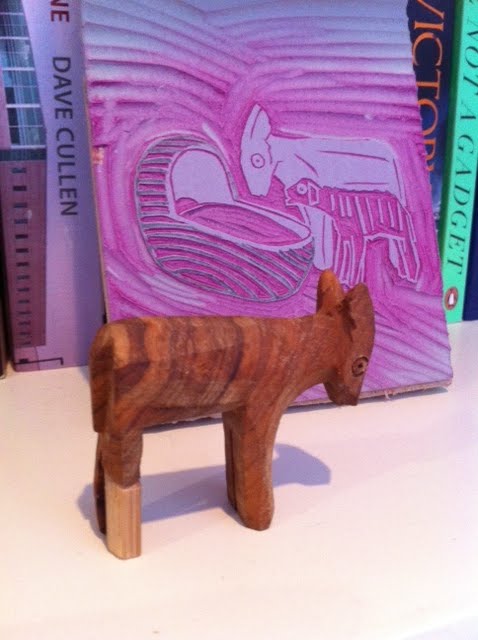
Donkey and Lamb and Baby Jesus Christmas Card Lino Print

I made a Christmas card for my Mum again this year. Slightly different style to our own card. For one thing, it's roughly 100% more Christian, and it's also simpler and more graphic.

Last year's card for Mum was a stylised depiction of Mary and Joseph, inspired by the wooden figures in the old family crib. This year I started with a sketch of three of the actual figures. A handsome, if hungry-looking, donkey, an astonished lamb with a substantial underbite, and Baby Jesus himself, carved by my Dad, if I remember rightly.


I think it's turned out nice, but the project has had a traumatic epilogue: at some point during his stay in our house the donkey had his leg snapped off (and lost). I feel horribly guilty about this, and have embarked upon a complex prosthetic treatment which has so far involved some Copydex and a chop stick (whittled) and will probably involve staining with tea at some point. Pray for him. Or not, depending how Hitchens you're feeling right now.


Wednesday, 7 December 2011

Mistletoe Christmas Card Lino Print

My Christmas card usually refers to something we did as a family during the year. This one takes a bit of explaining.

At Easter we made a trip to S's mum's place in Dumfrieshire, and were joined by my old friend L and her family. One of the highlights of the trip was a visit to Cream o' Galloway. A dairy farm for generations, it has evolved into a very contemporary outfit with excellent environmental and animal welfare credentials. They draw masses of visitors for their two big attractions: an ice cream factory and a kids' adventure park. The latter is so good that B, after a blast round the pedal go-kart track, and in context of a conversation about his late grandfather, declared "I'd like my ashes scattered at Cream o'Galloway".

It was a big highlight of the holiday for both families, so I was delighted when L turned up to see us some months later, holding an earthenware cream pot from Cream o' Galloway, presumably pre-war, which she'd happened upon at a car boot sale in Colchester.


S suggested it would be a handsome subject for our Christmas card, perhaps with the addition of some mistletoe.

This would have been tricky in October, but for the kindness of a chap called Simon at the English Mistletoe Company. The stuff doesn't normally go on sale till much later, so when I called the EMC to buy some, they told me none of it was ready; it was berryless. Excellently, though, when I explained what I was doing, Simon found their first couple of sprigs of mistletoe with berries on and posted them to me for the card.


I'm really happy with the card. I knew that some of the fine lettering wouldn't be legible, but I was determined to try to render it all, somehow, and I think a decent proportion of it comes out. The leaves are nicely shaped, and overall it has a subtly Christmassy and very two thousand and eleveny feel for me.


Thursday, 27 October 2011

#Linocabins

One of the finest parts of our truly fine holiday in Canada two summers ago was a stay at Ocean Village beach resort in Tofino, on the west coast of Vancouver Island. It's clean, it's friendly, and it's composed of upside-down-boat-shaped cabins with timber ends and shingled roofs (which are also the sides). But most importantly for us, it's partly owned by my brother in law R. He moved to Vancouver in the 80s and has managed to do ethical and environmental property development in a way I find extremely admirable. He's also, my wife informed me over the summer, a perfect bugger to buy a present for.

So she asked me to make a print depicting Ocean Village for R's 50th birthday, and here's how it went.

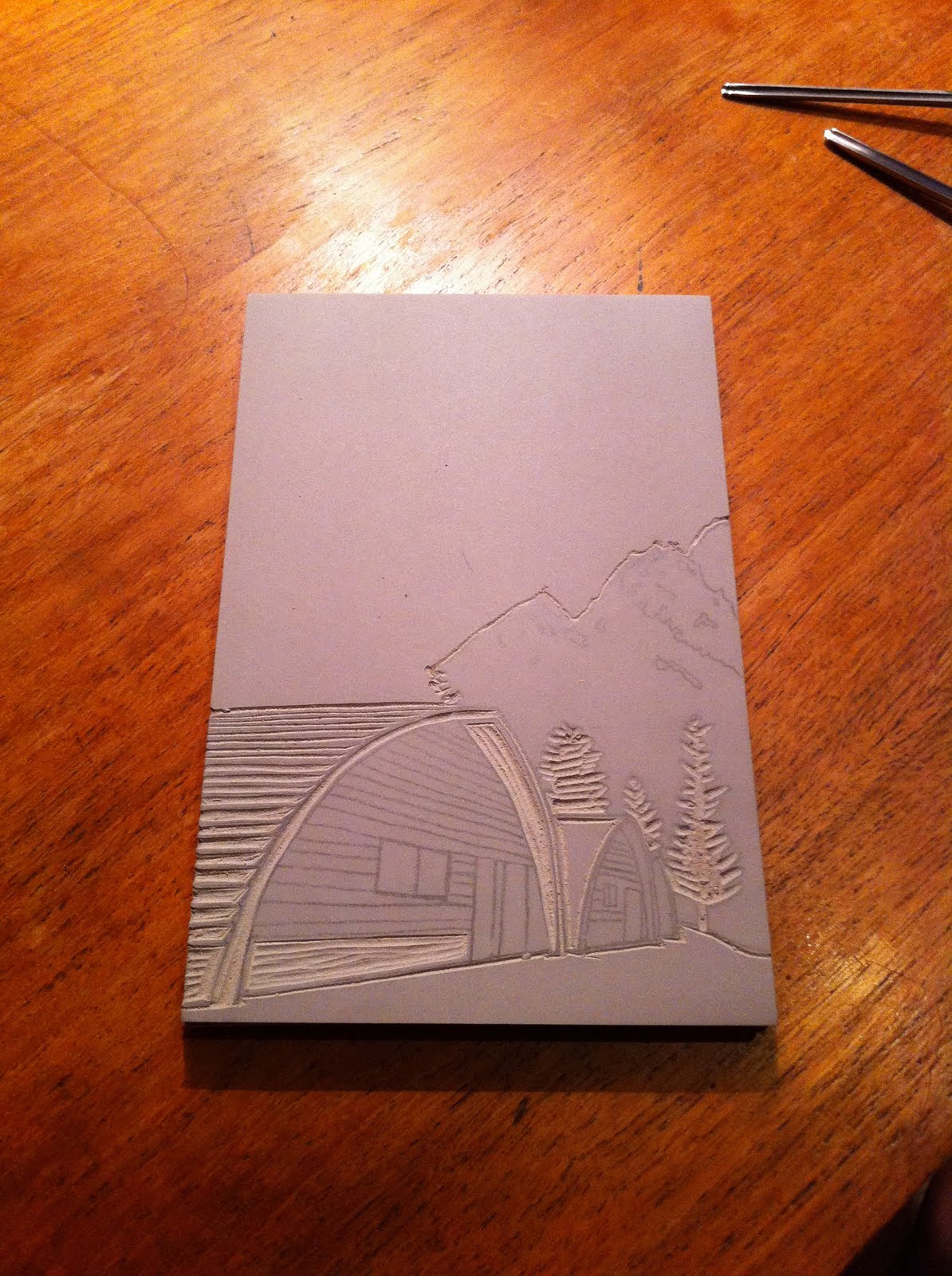
Firstly I composed a scene of cabin+trees+mountains which was a blend of my own photos and the rather finer ones on the Ocean Village site.

I'd never based a lino print on a black key line (I think that's the right term) before, but I admire lots of printers who work, or worked, in that style, not least the rightly unavoidable Edward Bawden. I suppose it allows you to get the best of both lino worlds: graphic boldness and multiple colours.

Anyway, the key line was made like this:


... and, once printed, looked like this:


Then I realised I ought to print that last, so I did two colour prints:


and bunged the black on last:


I really like the design, and I'm happy to have nailed the registration, though I'm still mystified at that patch of paleness caused by some irregularity in the pressure of my press, I assume. And I'm not that happy with the colours, truth be told. I have such poor judgement of colour. These multi-layer jobs always look too deep and dark to me, once done. Hey ho, S liked it and R liked it, so job done.

Saturday, 10 September 2011

Linofish

My lovely friend L asked me some months ago if I'd do a lino print for her 40th birthday. Naturally I wasn't paying attention, so I accidentally undertook this commission a year early.

The subject was a piece of art I've admired for years: a grouping of four driftwood fish created by L's mother, which hangs above the fireplace in the family's cottage in Suffolk.


Most of my prints are made over a number of weeks, with odd evenings and chunks of weekends here and there, but I had the blissful experience of doing most of this on one day, because S had taken the kids to Scotland. I spent the entire day printing, baking and listening to the Test match, and if you think that sounds middle aged ... then you're right, but sod it.

The other novelty for me was tweeting my progress, which led to lots of nice reaction to my #linofish tagged pics from @jbsurrey @wayfaringreader @ifiwasacupcake @iamamro and @vicnicolas (my sister, in truth).

First came the sketch. Quite straight. Bit simplified:


... transferred onto lino using that classic tracing paper rubbing technique which has served me well since primary school:


First layer (of three) gouged and ready to ink:


Out with the inks (in their lovely new box, found at a car boot sale):

First layer, inked:


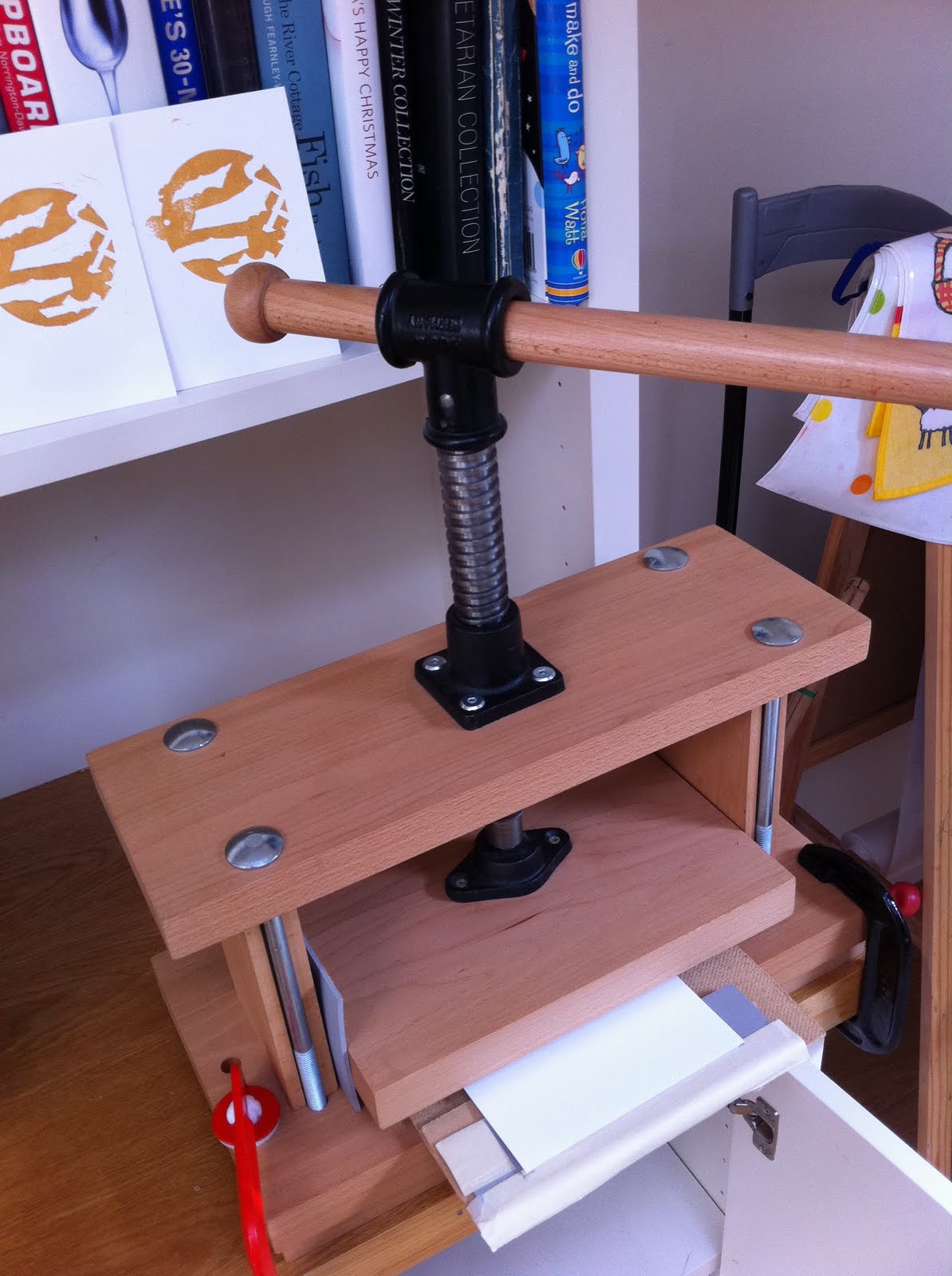
Out comes the press:


... fast forward to all three layers having been gouged:


Fortunately the registration of the layers was working out well (ie they fitted together):


The first combination of colours was a bit too heavy (always been my Achilles' bugbear):


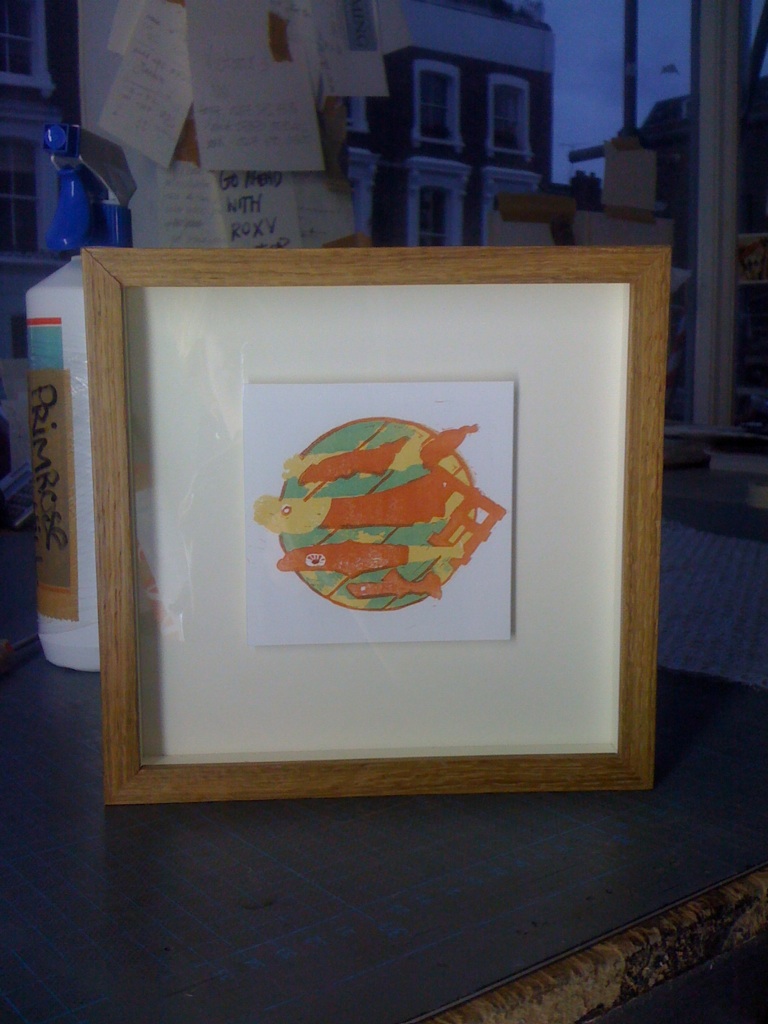
... so I tried again, and here's the finished picture (the photo is rather orangey for some reason):


Then, excellently, L's wonderful sister E framed it as her present to L. I think she did a beautiful job: